“I’m already old, so I don’t have stem cells anymore”—this common assumption explained from a medical perspective
Conclusion first
Medically, there is no age at which stem cells “completely disappear.” What changes with aging are three things: quantity, quality, and surrounding environment. Both “it’s useless because I’m old” and “I’m still young so I’m fine” are inaccurate assumptions.
* Stem cell function and regenerative capacity vary by individual. This article is intended to provide medical information and does not guarantee specific treatment outcomes.
“I’m already old, so I probably don’t have any stem cells left, right?”—many patients say this when they come in for consultation. In their 50s, 60s, 70s… the older they are, the more this statement carries a tone of resignation. Recovery feels slower, fatigue lingers longer, and it feels like aging is unavoidable. That feeling is not wrong. However, the idea that “stem cells are gone” is not medically accurate.
Bone marrow, muscle, skin, adipose tissue, and the nervous system—all of these tissues retain stem cells throughout life. Stem cells do not disappear; rather, they become less functional. Understanding this is the starting point for correctly thinking about aging and regenerative medicine.
What is stem cell aging: not “disappearing,” but “changing”
In the field of aging biology, the decline in stem cell function associated with aging is referred to as “stem cell exhaustion.” This does not mean they disappear; rather, accumulated DNA damage, chronic inflammation, and repeated cellular stress from division lead to a state of reduced regenerative capacity.
The reason wounds heal more slowly with age is not because stem cells have “vanished,” but because of this complex deterioration of the surrounding environment.
How stem cells change with aging: three key changes
Why do people of the same age have different recovery capacities? There are three common patterns in how stem cells change with aging.
change01
Decrease in number — differences between bone marrow and adipose tissue
Research shows that the pool of functional stem cells in bone marrow decreases with age. In contrast, adipose tissue (subcutaneous and visceral fat) contains a rich supply of mesenchymal stem cells and tends to retain relatively higher levels even with aging.
Mesenchymal stem cells are a type of stem cell capable of differentiating into various tissues such as bone, cartilage, fat, and muscle. One reason adipose tissue is attracting attention in regenerative medicine is its strong capacity to retain these cells.
change02
Change in quality — “quality” matters more than “quantity”
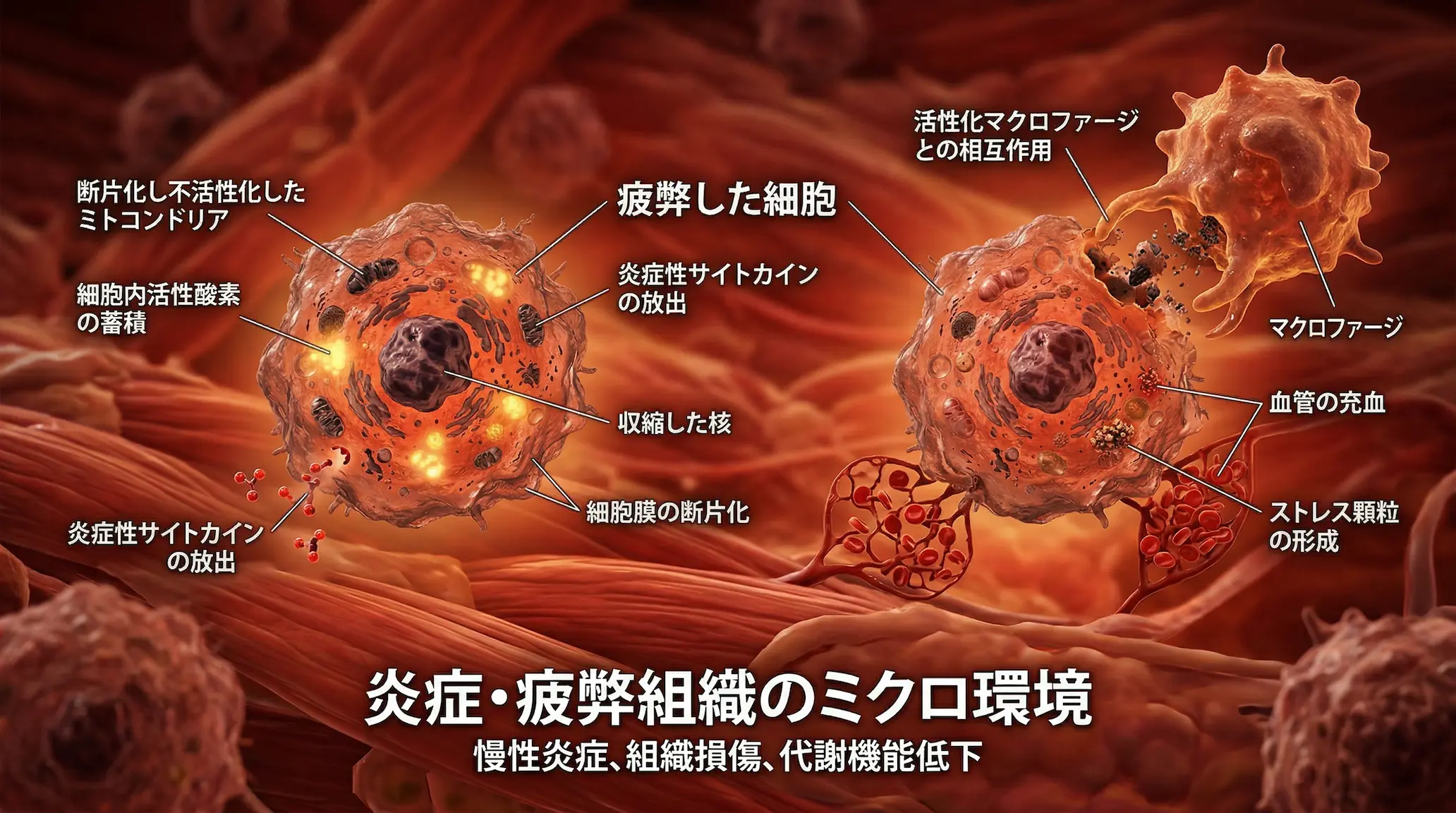
Aging stem cells show reduced ability to proliferate, migrate, and respond to injury. They are more likely to enter a “senescent state” (a fatigued, non-functional condition) and are more prone to natural cell death.
Here is something many people find surprising: a small number of healthy, highly responsive stem cells can outperform a large number of dysfunctional stem cells in an inflammatory environment. This is a key finding from medical research. In other words, neither “I’m still young, so I’m fine” nor “I’m old, so it’s pointless” is accurate.
Chronic inflammation accelerates the decline in stem cell function
change03
Deterioration of the surrounding environment — combined effects of inflammation, metabolism, and hormones
Chronic inflammation, metabolic imbalance, oxidative stress, and hormonal changes—when these factors overlap, they create an environment in which stem cells cannot function properly, even if they are present.
Obesity, insulin resistance, lack of sleep, chronic stress, and smoking—all accelerate this process. Conversely, improving these factors helps maintain regenerative capacity beyond age. What matters is not “how old you are,” but “what condition your body is in right now.”
The Leading Cause Accelerating Stem Cell Aging: Chronic Inflammation
Chronic inflammation is a central factor in the age-related decline of stem cell function. Inflammatory cytokines (signal molecules in the body that trigger inflammation) disrupt the normal function of stem cells and promote cellular aging. Inflammation is both a “result of aging” and a “cause of aging.”
That is why, in regenerative medicine, controlling inflammation is an essential prerequisite for treatment.
Quantity
Number of stem cells decreases
Particularly pronounced in bone marrow; adipose tissue tends to retain more
Quality
Stem cell quality changes
Even a small number of high-quality cells can outperform a large number of dysfunctional ones
Environment
Surrounding environment deteriorates
Chronic inflammation, metabolic imbalance, and hormonal changes impair function
Is There an “Optimal Age” for Regenerative Medicine?
There is no single “optimal age.” However, timing is important. Intervening before advanced degeneration or irreversible tissue loss occurs is generally associated with better outcomes. That said, this does not mean that it is “too late” at an older age.
It is important to set expectations based on biological reality, aligned with your current condition and goals. Regenerative medicine does not aim for “reversal,” but rather to maximize the body’s remaining regenerative potential.
What Are Adipose-Derived Stem Cells (ASC)? Their Role and Prerequisites in Regenerative Medicine
As cells that support the body’s “baseline enhancement,” Ginza YR Clinic focuses on adipose-derived stem cells (ASC). Here we explain their biological characteristics and the prerequisites for treatment.
ASCCharacteristics
Biological Characteristics of ASC (Reported in Basic and Clinical Research)
Adipose tissue is known as one of the body’s richest sources of mesenchymal stem cells and can be harvested relatively easily with minimally invasive procedures, making it widely studied in regenerative medicine (Zuk et al. 2002 / Gimble et al. 2007).
Basic and clinical studies have reported the following biological properties of ASC:
・ Reported to secrete bioactive molecules (paracrine factors) that suppress inflammatory cytokines
・ Shown to regulate immune responses and mitigate excessive inflammation
・ Confirmed to release signals that support the survival and function of surrounding tissue cells
・ Demonstrated the ability to differentiate into multiple cell lineages such as bone, cartilage, fat, and muscle
* Paracrine factors are signaling molecules released by cells that act on nearby cells.
ASCPrerequisites
ASC Effectiveness Depends on the Patient’s Health and Metabolic Environment
ASC therapy is typically an autologous transplant using the patient’s own adipose tissue. Therefore, the quality of harvested cells directly depends on the patient’s health status, age, and metabolic environment. It is not just about having enough cells—the key is that the cells are in a condition where they can function properly.
The following conditions have been reported to affect ASC function:
⚠ Obesity ⚠ Diabetes ⚠ Chronic inflammation
That is why optimizing inflammation, metabolism, and lifestyle is the foundation for maximizing the effectiveness of ASC therapy. Treatment is not about “replacement,” but about working with the body’s internal environment.
Summary: Moving Beyond the Assumption That “It’s Too Late Because of Age”
✓ There is no age at which stem cells “completely disappear”
✓ Aging affects three factors: quantity, quality, and environment
✓ “Quality” matters more than “quantity” in treatment outcomes
✓ Inflammation is a key driver accelerating stem cell aging
✓ The essential question is not “how old you are,” but “the current state of your body”
✓ Regenerative medicine aims to “enhance,” not “reverse”
✓ ASC effectiveness depends on the patient’s health, age, and metabolic condition
* This article is intended to provide medical information and does not guarantee specific treatment outcomes. Individual results may vary. Please consult a physician for details.
Regenerative Medicine at Ginza YR Clinic: Adipose-Derived Stem Cell (ASC) Therapy
Inside Ginza YR Clinic
We provide adipose-derived stem cell (ASC) therapy for both whole-body care and joint conditions.
Based on the philosophy of “Ageing Well”—not resisting aging, but aging healthily and authentically—we aim to support the body’s remaining regenerative potential regardless of age by combining inflammation control, metabolic improvement, and lifestyle optimization.