








Regenerative Medicine / Hair Loss | Case Report — Scalp Series (Female Pattern Hair Loss)
Dr. Junya Higuchi, Director, Ginza YR Clinic
MD, PhD (University of Tokyo) / Board-Certified Orthopaedic Surgeon / Certified Regenerative Medicine Physician, Japan Society for Regenerative Medicine / JSPO-Certified Sports Doctor
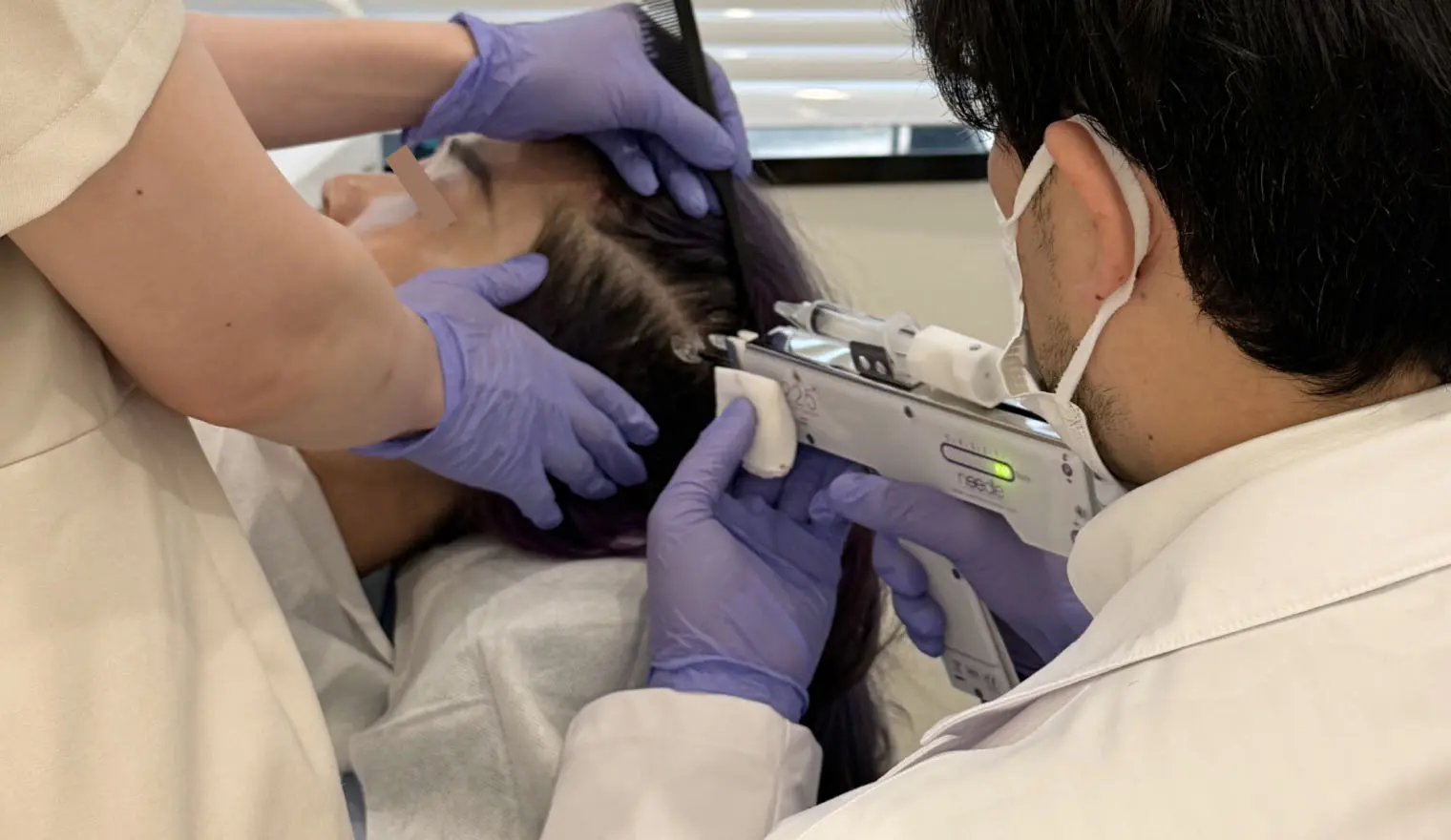
Delivering umbilical cord-derived stem cell secretome into the dermal layer of the scalp with the Mesogun U225 is one approach used for female pattern hair loss (FAGA), where the hairline recedes and the part widens. Sessions are generally spaced about a month apart. This article documents a 37-year-old woman across four sessions: photographs showed a change in density along her part and fine vellus hairs emerging at the sides of her front hairline.
Results vary from person to person. The same changes cannot be guaranteed.
The photographs and information in this article are published with the written consent of the patient. What is described here is one individual case and is not a guarantee that anyone else will see the same changes. Whether the treatment is appropriate depends on each person’s condition.
- ✓Female pattern hair loss often becomes noticeable from the late thirties, with changes concentrated across the front and crown — the part line in particular. Several factors are thought to contribute.
- ✓Umbilical cord-derived stem cell secretome contains bioactive substances including growth factors and exosomes. Its relationship with the environment surrounding the hair follicle is currently under research.
- ✓The Mesogun U225 makes it easier to deliver these components evenly across a wide area of scalp, so the hairline, the sides of the front hairline and the part can all be covered in a single session.
- ✓In this case, four sessions were completed. From the third session onward, photographs showed fine vellus hairs at the sides of the front hairline and a change in density along the part.
- ✓The degree of change varies from person to person. Suitability for treatment is assessed individually by a physician at consultation.
1. About this patient
| Age / Sex | 37 / Female |
|---|---|
| Main concern | Receding hairline, thinning at the sides of the front hairline, and scalp showing through along the part, due to female pattern hair loss (FAGA) |
| Reason for visit | Presented with female pattern hair loss affecting the hairline, the sides of the front hairline and the part |
| Treatment | Umbilical cord-derived stem cell secretome delivered with the Mesogun U225 — 4 sessions |
| Interval | Approximately monthly (actual intervals: about 1–2 months) |
| Treatment period | December 2025 – April 2026 (4 sessions) |
| Treatment area | Hairline, sides of the front hairline, area around the part (whole scalp) |
| Cost | ¥96,800 per session (tax included) |
Hair loss in women — female pattern hair loss in particular — is often assumed to be less visible than it is in men. In practice, plenty of women begin noticing a receding hairline from their late thirties, along with thinning at the sides and scalp showing through the part. Shifts in hormone balance, stress and changes in the scalp environment are all thought to play a part.
At Ginza YR Clinic, a 37-year-old woman presenting with female pattern hair loss received four sessions of umbilical cord-derived stem cell secretome delivered with the Mesogun U225, with her scalp condition recorded before and after treatment.
2. What is female pattern hair loss?
How hair loss presents in women, and what changes after the late thirties
Female pattern hair loss — FAGA, or female androgenetic alopecia — is a form of hair loss in women that tends to progress differently from male AGA. In men, the front hairline typically recedes into an M shape and the crown thins. In women, the pattern is usually a widening part and a general drop in hair volume, though changes at the hairline and at the sides of the front hairline also occur, as in this case.
Female pattern hair loss is thought to involve several factors at once: shifts in oestrogen balance, scalp circulation, and disruption to the hair growth cycle. One of the options offered at Ginza YR Clinic is delivering growth factors and other bioactive substances into the dermal layer of the scalp using the Mesogun U225 — an approach whose relationship with the environment around the hair root is under research. Results vary from person to person.
3. What is umbilical cord-derived stem cell secretome?
What the Mesogun U225 is actually delivering
The secretome is the collective term for the range of bioactive substances that cells release. It is the mixture of active components secreted by umbilical cord-derived stem cells during culture, and includes exosomes as well as growth factors, cytokines and other substances involved in cell-to-cell signalling.
| Component | Reported involvement in research |
|---|---|
| Growth factors (FGF2, HGF and others) | Their relationship with cell-to-cell signalling and with maintaining tissue condition is under research.1,2 |
| Exosomes (CD63 and others) | Understood to be involved in cell-to-cell signalling; their influence on the cellular environment of the scalp is under research.3 |
| Cytokines and chemokines | Reported as possibly involved in modulating inflammation.4 |
| ECM (extracellular matrix) proteins | Their relationship with structural support of scalp tissue is under research.5 |
We use the Mesogun U225 to deliver these components evenly into the dermal layer of the scalp, with the aim of supporting the environment around the hair follicle. Results vary from person to person.
Note: the above refers to basic research and animal studies on components contained in the secretome. It is not evidence of the effect of this treatment.
4. Why the Mesogun U225
Delivering evenly to the hairline, the sides and the part
The Mesogun U225 uses multiple fine needles to inject automatically at a set depth and a set volume, which makes it easier to distribute components evenly across a wide area of scalp. Where thinning spans several areas at once — the hairline, the sides of the front hairline and the part, as in female pattern hair loss — an approach that covers a broad area efficiently is worth considering. For cases like this one, Ginza YR Clinic works across the whole scalp using the Mesogun U225.
5. Age 37, female pattern hair loss — record of four sessions
Published with the written consent of the patient. Results vary from person to person and the same changes cannot be guaranteed.
Dates photographed: Session 1, 4 December 2025 / Session 2, 8 January 2026 / Session 3, 11 March 2026 / Session 4, 8 April 2026
| Treatment | Umbilical cord-derived stem cell secretome delivered with the Mesogun U225 — 4 sessions |
|---|---|
| Interval | Approximately monthly (actual intervals: about 1–2 months) |
| Cost | ¥96,800 per session (tax included) |
Back — part line and crown

At the first visit, before treatment, the scalp was visible through the part. Photographs were taken throughout the four sessions, and by the fourth, density around the part had changed.
Right side — hairline and front

A record of the right side, from the hairline through the front. From the third session (11 March 2026) onward, fine vellus hairs were visible in the photographs just inside the hairline.
Left side — hairline and front

A record of the left side, from the hairline through the front. As on the right, vellus hairs appeared from the third session, and by the fourth these had become established.
This is the treatment record of one particular patient. Lighting, camera conditions and how the hair is parted can all change how the photographs look. Results vary from person to person and the same changes cannot be guaranteed.
GINZA YR CLINIC
Consultations and bookings
WebBook online
By appointment only | Ginza, Tokyo | Private-pay treatment
The online booking page is in Japanese. For assistance in English, please call us or use the enquiry form on our website.
6. Who may consider this treatment, and who cannot receive it
The above is a general guide only. Whether treatment can proceed is decided individually by a physician at consultation.
Main side effects and risks
Whether side effects occur, and how pronounced they are, varies from person to person. Please contact us straight away if anything concerns you.
7. Important information (unapproved medical device and unapproved pharmaceutical)
Redness or puffiness may occur on the day (usually settling within a few hours to about three days). Bruising occurs occasionally (usually resolving within about a week). An allergic reaction to the substances used is possible.
① The Mesogun (U225) used in this treatment is an unapproved medical device that has not received approval under Japan’s Pharmaceuticals and Medical Devices Act.
② The device was obtained by the physician through personal importation. (Reference: Ministry of Health, Labour and Welfare, “To those considering purchasing pharmaceuticals from overseas”)
③ There is no domestically approved medical device with equivalent performance approved for the same purpose as this treatment.
④ The device holds CE certification in Europe, but its safety and efficacy have not been sufficiently established within Japan. Treatment may cause redness, swelling, pain, bruising, infection, pigmentation, scarring or allergic reaction.
⑤ In the unlikely event of a serious adverse reaction or health damage, it would fall outside the scope of Japan’s national relief system for adverse drug reactions.
This treatment administers secretome cultured and manufactured at a domestic facility from umbilical cord stem cells of Japanese donors, delivered into the scalp with the Mesogun U225. It is a preparation studied for its role in supporting balance in the body’s internal environment and in tissue repair.
Course length and number of sessions: we generally plan around one session per month, four to six sessions in total. The number and spacing are decided in discussion with your physician.
Cost (as treated in this case): ¥96,800 per session (tax included)
Main risks and side effects: mild pain or swelling may occur at the injection site (easing within a few days). A temporary sensation of warmth or fatigue occurs occasionally (typically settling within 1–2 days).
① The umbilical cord-derived stem cell secretome used in this treatment is an unapproved pharmaceutical that has not received approval under Japan’s Pharmaceuticals and Medical Devices Act.
② It is sourced from umbilical cord tissue of healthy Japanese donors, obtained through a route serving domestic medical institutions.
③ There is no domestically approved pharmaceutical with equivalent components or performance.
④ It is not approved in the major countries of Europe or North America. Significant risks may therefore remain unidentified.
⑤ In the unlikely event of a serious adverse reaction, it would fall outside the scope of Japan’s national relief system for adverse drug reactions.
Enquiries: Ginza YR Clinic +81-3-6263-9219
8. Frequently asked questions
A note from the director
Female pattern hair loss is often treated as less serious than hair loss in men. In reality, a great many women from their late thirties onward come to us about changes at the hairline, at the sides of the front hairline and along the part. This is an age at which hormonal shifts, stress and the condition of the scalp tend to compound one another, and care applied only from the outside can be hard to feel the benefit of.
Umbilical cord-derived stem cell secretome contains a number of bioactive substances, growth factors among them, and has been reported as potentially supporting the cellular environment around the hair root. Delivering it evenly into the dermal layer with the Mesogun U225 allows several areas — hairline, sides and part — to be addressed at once.
In this case, four sessions were completed, and from the third session onward the photographs showed vellus hairs at the sides of the front hairline along with a change in density along the part. How much changes and when varies considerably with the stage of the condition, age and lifestyle. Looking at female pattern hair loss as a question of tissue environment, through the lens of regenerative medicine, is one of the things that characterises our approach at Ginza YR Clinic. Suitability differs from person to person, so please start with a consultation.
GINZA YR CLINIC
With hair loss in women, the moment you notice is the moment to ask.
Dr. Higuchi assesses the condition of your scalp at consultation and proposes a suitable combination from mesogun delivery, secretome, PRP and oral medication.
By appointment only | Ginza, Tokyo | Private-pay treatment
References
- Promotion of hair growth by a conditioned medium from human umbilical cord mesenchymal stem cells cultivated in a 3D scaffold of gelatin sponge. European Journal of Medical Research. 2024. doi:10.1186/s40001-024-01830-7
- Synergistic effect of PDGF and FGF2 for cell proliferation and hair inductive activity in murine vibrissal dermal papilla in vitro. Journal of Dermatological Science. 2015.
- Exosomes from human umbilical cord mesenchymal stem cells promote the growth of human hair dermal papilla cells. PMC12043141.
- Insights into the Secretome of Mesenchymal Stem Cells and Its Potential Applications. International Journal of Molecular Sciences. 2019;20(18):4597.
- The secretion profile of mesenchymal stem cells and potential applications in treating human diseases. Signal Transduction and Targeted Therapy. 2022. doi:10.1038/s41392-022-00932-0
- In vitro and clinical evaluation of umbilical cord-derived mesenchymal stromal cell-conditioned media for hair regeneration. Journal of Cosmetic Dermatology. 2022;21:740-757. doi:10.1111/jocd.14114
- The human umbilical cord-mesenchymal stem cell secretome regulates hair growth and cycle transition by promoting methylthioadenosine synthesis via the PI3K/AKT/mTOR pathway. Stem Cell Research & Therapy. 2025. doi:10.1186/s13287-025-04806-4
- Han HS, Park KY, Ko EJ, Kim BJ. Efficacy of a Hair Tonic Containing Human Umbilical Cord Blood Mesenchymal Stem Cell-derived Conditioned Media in Patients with Androgenetic Alopecia. Korean Journal of Dermatology. 2019;57(5):251-257.
- Migration Inhibitory Factor in Conditioned Medium from Human Umbilical Cord Blood-Derived Mesenchymal Stromal Cells Stimulates Hair Growth. Cells. 2020;9(6):1344. doi:10.3390/cells9061344
The publications above are general research reports on umbilical cord-derived stem cell secretome and the components it contains. They are not clinical trials of the specific preparation used at this clinic.
Most are based on cell or animal studies; efficacy in humans has not been established.
The clinical studies among them used topical preparations, and the route of administration differs from the scalp delivery (injection) described in this article.
This article is provided for information only and does not guarantee or claim any specific therapeutic effect.
The clinical studies reported in references 8 and 9 used a topical hair tonic. The preparation and route of administration differ from the treatment described here, so they do not indicate equivalent results.
Reviewed by Dr. Junya Higuchi, Director, Ginza YR Clinic (MD, PhD, University of Tokyo; Board-Certified Orthopaedic Surgeon; Certified Regenerative Medicine Physician, Japan Society for Regenerative Medicine; JSPO-Certified Sports Doctor)
This article is provided for information only and is not a recommendation to undergo any medical procedure. Suitability and risks differ from person to person. Please make any decision under the examination and guidance of a physician.
Ginza YR Clinic | +81-3-6263-9219 | yrclinic.com